
photo credit: Ryan Stone
Unchecked, authority inevitably destroys- Albany can fix this – but will they?
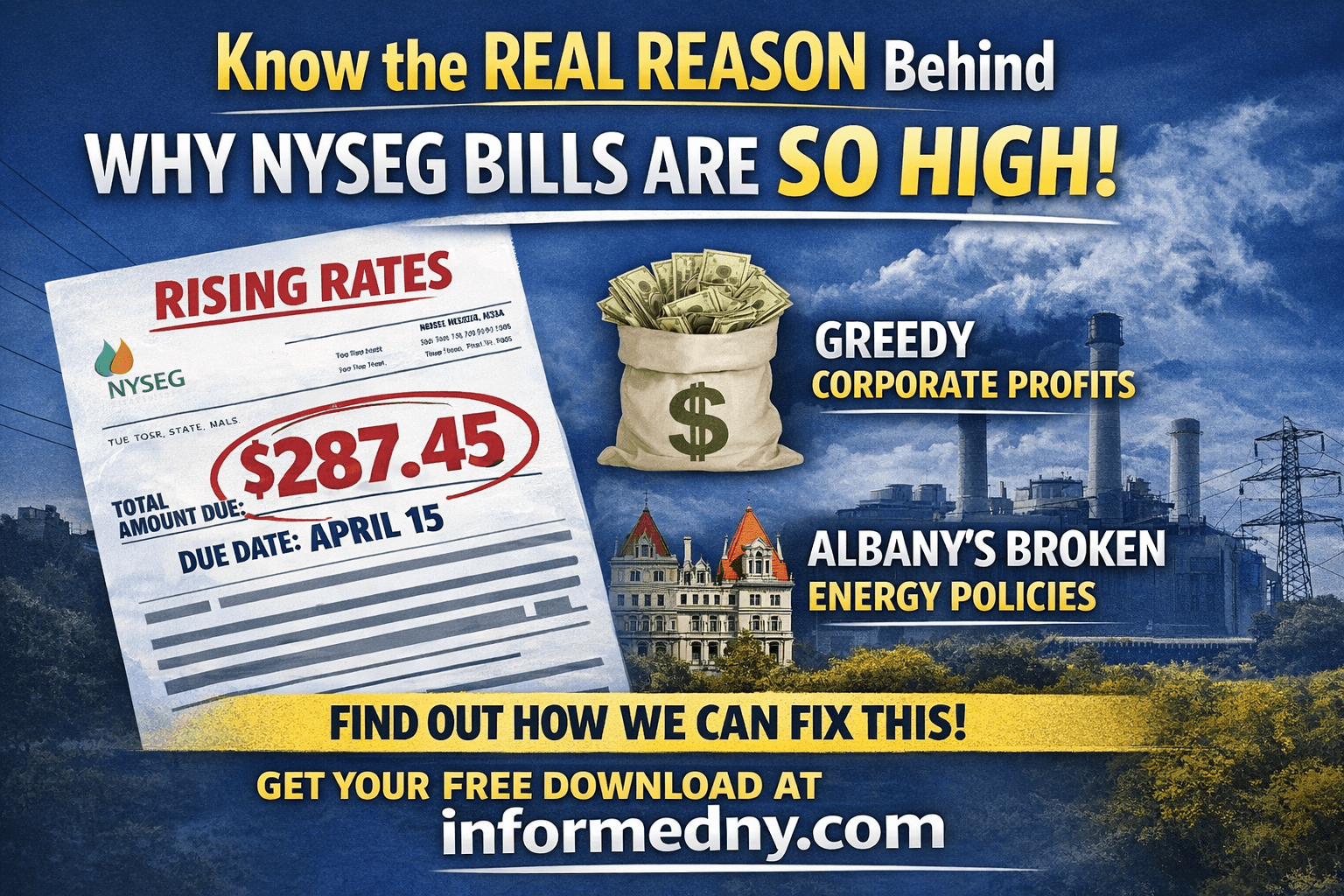
Are you ready to understand why our bills are high?
Bet you will not be surprised when I tell you its because of Albany.
I am going to give you the long version so you really understand what is going on and then I need you to share this so we gain the attention of those who can change it.
First thing you need to know is that hearings are going to do nothing and Albany knows this – its just to pacify us.
What we need to do is we need to convince our State legislators to stop playing with us and make one simple change that will bring down our bills.
So here we go . . .
NYS created a NYSEG monopoly and stopped holding it to real accountability. So yes you are right to feel unheard because NYSEG and other utility companies operate as state sanctioned monopolies.
NYSEG answers to the Public Service Commission, and the Public Service Commission answers to Albany. Public Service Law Section 4 creates the PSC and ties it to the state government placing it inside the executive branch of the NYS government.
So the Governor influences policy priorities and regulatory posture and the legislature can write or amend the laws. But they refuse to do so. They make small changes that do not help us at all but they fail to make the right decisions.
The rules right now are that the PSC regulates NYSEG by reviewing their operating costs, infrastructure spending, debt structure, allowed profit and service performance. Executive compensation is included in operating costs and remember NYSEG is owned by Avangrid, which is part of Iberdrola so executive compensation is reported at the parent-company level and for the top 5 executives alone NYSEG dishes out about $25 million dollars in compensation.
Meanwhile, the regulatory system doesn’t reward utilities for saving money. It rewards them for spending it including spending it on salaries of those in Spain with the parent company. And Albany has designed things so the more spending that gets approved, the more profit the company can earn.
Let me give you an example. Remember how I said utilities are allowed to earn about a 9 percent profit, and now they’re pushing closer to 10. Grocery stores only make about 1 to 3 percent, so 9 sounds big, but the percentage itself isn’t really the issue.
The issue is how that percentage works. Utilities earn that return on the value of all the equipment and infrastructure they build, what’s called the rate base. So if their system is worth five billion dollars, they earn profit on that. But if they replace more equipment before they need to be replaced, expand projects, and grow that value to eight or nine billion, they still earn the same percentage just on a much bigger number. Under the old system, if the utility’s infrastructure was worth about five billion dollars, a 9 percent return meant roughly 450 million in profit. But if the system expands to eight billion dollars, that same 9 percent suddenly means about 720 million. Same percentage, much bigger bills.
That’s what compounds over time. Not the rate, but the size of what they’re allowed to earn it on. And because your bills have to cover those investments plus the guaranteed return, the more the system grows, the more delivery charges tend to rise.
So the system doesn’t really reward utilities for saving money. It rewards them for building more, because the more they build, the more they’re allowed to earn.
This is why oversight matters, and why we need to move from a system that rewards spending to one that rewards performance and results for customers. That doesn’t mean cutting local jobs, because that hurts our economy, but it does mean demanding accountability, including looking at executive compensation at the parent company level, which is based in Spain, and making sure costs are justified before they reach ratepayers.
If utilities earn their full return only when they control costs, reduce outages, and deliver reliable service, and if they use lower-cost public-style financing like municipalities do to keep interest down, the result can be smarter spending, more stability, and more protection for families’ bills. And this is an easy fix if those in Albany would just take the time to read the old wording from 25 years ago and apply economics 101 to the equation.
Visit the InformedNY Round Table
for discussions on issues like these
https://www.facebook.com/groups/informednyroundtable
#HealthINY #FollowTheMoneyINY #EnvironmentINY- #LegislationINY –